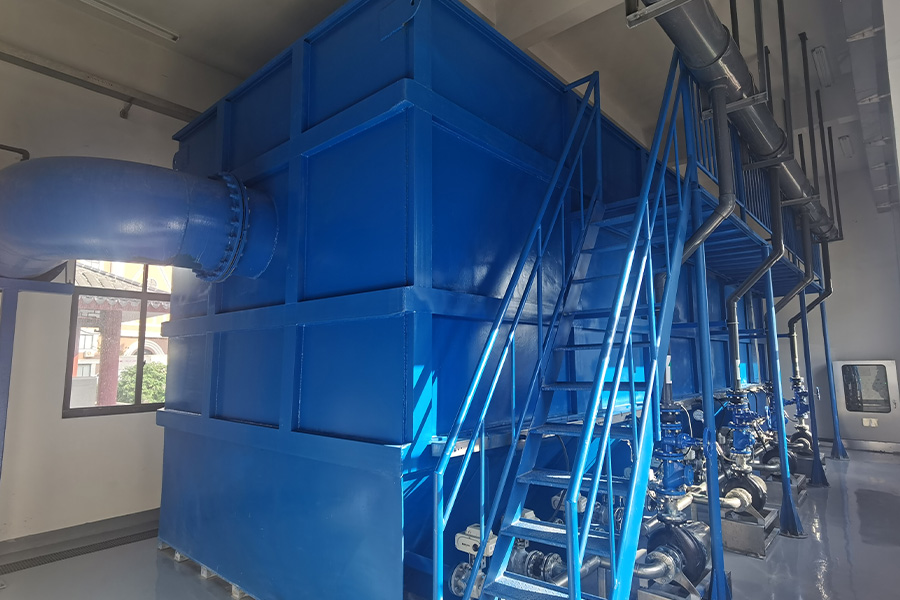
Tertiary Wastewater Cloth Media Filter
The Wastewater Advanced Filtration System is a core device for tertiary wastewater treatment, designed to address challenges of meeting discharge/reuse standards after secondary treatment. Utilizing high-precision fiber filter media and optimized flow field design, it deeply intercepts residual suspended solids (SS), colloids, partial COD, and phosphorus pollutants, ensuring stable effluent quality compliance with Class IA standards of the Discharge Standard of Pollutants for Municipal Wastewater Treatment Plants (GB 18918-2002) (SS≤5mg/L) or stricter reuse requirements.
Tertiary Wastewater Cloth Media Filter
I. Product Overview
The Wastewater Advanced Filtration System is a core device for tertiary wastewater treatment, designed to address challenges of meeting discharge/reuse standards after secondary treatment. Utilizing high-precision fiber filter media and optimized flow field design, it deeply intercepts residual suspended solids (SS), colloids, partial COD, and phosphorus pollutants, ensuring stable effluent quality compliance with Class IA standards of the Discharge Standard of Pollutants for Municipal Wastewater Treatment Plants (GB 18918-2002) (SS≤5mg/L) or stricter reuse requirements.
II. Working Principles
The system operates on a "precision interception + dynamic purification" logic:
-
Advanced Filtration Stage
Post-secondary treated wastewater (e.g., from生化池) enters the filter tank via gravity flow. Water permeates outward-in through modified polyester fiber cloths, intercepting biological flocs, colloids, fine suspended solids, and phosphorus compounds (e.g., PAC-generated phosphate flocs). Treated water exits through hollow collection pipes for discharge or reuse.
-
Intelligent Backwashing Stage
Raw water flows into the main tank and through filter cloths via gravity. Filtered water is collected through filter discs and central pipes. As suspended solids accumulate on cloth surfaces, filtration rates decline and tank water levels rise. When levels reach预设 thresholds or runtime limits, negative-pressure backwashing initiates. Rotating discs clean cloth surfaces while maintaining continuous filtration.
-
Auxiliary Sludge Discharge
A conical sludge hopper at the tank bottom periodically discharges settled sludge via pumps, preventing secondary pollution and ensuring long-term efficiency.
III. Technical Parameters
|
Parameter |
Wastewater Advanced Filtration System |
|
Filtration Precision |
5-10μm (customizable to 3μm for low-turbidity reuse) |
|
Processing Capacity |
1,000-30,000 m³/day per module (scalable beyond 200,000 m³/day) |
|
Influent Requirements |
Secondary effluent (SS≤20mg/L, Turbidity≤15 NTU) |
|
Effluent Quality |
SS≤5mg/L (Class IA), Turbidity≤1 NTU; SS≤3mg/L (customized) |
|
Pollutant Removal Rates |
SS≥90%, TP≥60% (with chemical coagulation) |
|
Backwash Water Consumption |
0.5-2% of treated volume (>50% less than sand filters) |
|
Head Loss |
0.5-1.0m (compatible with secondary effluent head) |
|
Backwash Interval |
60-120 min (auto-adjusted by SS) |
|
Installed Power |
≤3kW per module (incl. backwash pump/drive motor) |
IV. Product Features
-
Superior Deep Purification Capability
Efficiently intercepts fine flocs, colloids, and dissolved organic precursors with 5-10μm cloths, achieving SS <5mg/L—far exceeding Class IA standards for downstream disinfection/reuse.
-
Robust Shock Load Resistance
Automatically shortens backwash cycles (min. 15 min) during SS surges (up to 50mg/L), ideal for rainy-season combined sewer overflows.
-
Retrofit-Friendly Design
-
Ultra-compact: 10,000 m³/day unit requires仅10-15㎡ (1/5 footprint of traditional V-filters).
-
Modular prefabrication enables plug-and-play installation within 30 days.
-
Ultra-Low Operating Costs
-
Power consumption ≤0.008kWh/ton (backwash-only).
-
2-3 year cloth lifespan; annual O&M costs 1/3 of conventional filters.
-
Process Compatibility
Seamlessly integrates with UV disinfection, ozonation, or membranes, reducing downstream fouling (e.g., >30% membrane cleaning reduction).
V. Applications
-
Municipal WWTP Upgrading
Replaces sand filters/clarifiers to meet Class IA standards. Example: A 50,000 m³/day plant in southern China achieved SS reduction from 20mg/L (Class IB) to <5mg/L using "biological treatment + fiber disc filters" within 80㎡.
This system addresses "compliance discharge" and "water reuse" demands in wastewater management. Through precision engineering and scenario optimization, it provides efficient, economical, and scalable solutions for treatment plants pursuing environmental compliance and resource recovery.
VI. Maintenance Guide
Proper maintenance ensures optimal performance and extends the lifespan of your cloth media filter:
-
Regular Inspection
Check filter cloth for tears or clogging every 1–3 months.
Inspect the backwash system for proper rotation and pressure.
-
Cleaning and Replacement
Replace filter cloth every 2–3 years or as needed based on water quality.
Periodically flush sludge hoppers and collection channels to avoid blockages.
-
Monitoring System Performance
Track differential pressure and flow rate to detect early signs of clogging.
Use automated alarms for abnormal water level or backwash failure.
-
Seasonal Adjustments
Adjust backwash frequency during periods of high inflow or rainy seasons.
Add coagulants or flocculants if turbidity or SS levels spike.
VII. Buying Guide
When selecting a tertiary wastewater cloth media filter, consider the following factors:
Flow Rate: Ensure the module capacity matches your facility’s peak flow requirements.
Filtration Precision: Choose a filter cloth suitable for your desired effluent quality.
Installation Space: Compact modular designs reduce footprint but confirm access for maintenance.
Integration Needs: Assess compatibility with your existing tertiary treatment systems (UV, ozone, membrane).
Operational Cost: Look for low backwash water usage and energy-efficient operation.
Service Support: Prioritize suppliers who offer installation guidance, training, and after-sales service.
VIII. Why Choose Us?
Choosing our advanced wastewater filtration system means choosing more than just efficient equipment; it also means choosing a professional and reliable partner:
-
Extensive Industry Experience
We have dedicated years of experience in the research and development, and application of advanced wastewater purification systems, providing proven solutions for various industrial and municipal water treatment projects, ensuring stable and efficient system operation.
-
Customized Solutions
Customized Solutions: Tailored tertiary filtration wastewater treatment designs to optimize performance and minimize costs.
-
Fast Delivery and Installation
Modular design and factory-prefabricated production ensure on-site installation and commissioning within 30 days, reducing construction time.
-
Comprehensive After-Sales Service
We provide system installation guidance, operational training, and remote technical support to ensure long-term, stable operation and peace of mind for our customers.
-
Continuous Innovation and Technical Support
Our R&D team continuously optimizes our advanced wastewater filtration system technology, continuously improving treatment capacity, energy efficiency, and impact resistance, helping customers meet future stringent discharge and reuse requirements.
For professional consultation, system design, and quotes, please contact our team. As a leading advanced water treatment plant, we provide customized solutions for wastewater treatment challenges.
IX. FAQ
Q1: What is the difference between a cloth media filter and traditional sand filters?
A: Cloth media filters achieve higher filtration precision (down to 3–5 µm) with much lower backwash water consumption. They are more compact and offer automated cleaning for continuous operation.
Q2: Can this system handle variable wastewater loads?
A: Yes, the system automatically adjusts backwash frequency during high load events, ensuring stable performance even with stormwater surges or industrial spikes.
Q3: How often should the filter cloth be replaced?
A: Depending on water quality, filter cloth typically lasts 2–3 years. Regular inspection ensures optimal filtration.
Q4: Can the system be integrated with other tertiary treatment methods?
A: Absolutely. Our tertiary filtration wastewater treatment system works well alongside UV, ozone, or membrane systems, reducing downstream fouling and maintenance.
Q5: What is the typical footprint of the system?
A: The modular design allows up to 80% space savings compared to traditional sand or V-type filters, making it suitable for retrofitting existing plants.
Q6: Is the system suitable for industrial wastewater?
A: Yes. It effectively removes suspended solids, colloids, and some phosphorus compounds from industrial effluents, improving effluent quality for discharge or reuse.
Related products
-
-
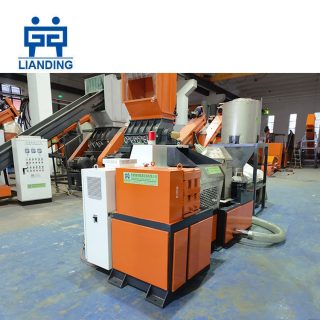
This is multifunctional small pelletizing line. It is used to recycle various leftovers, such as PP, PE, HDPE, LDPE, PVC, etc. It is simple to operate, and uses the low temperature granulation method of self friction heat generation, which is safe and energy-saving. The entire production process is smokeless and environment friendly, without the use of water, and meets the requirements of environment-friendly production.
-
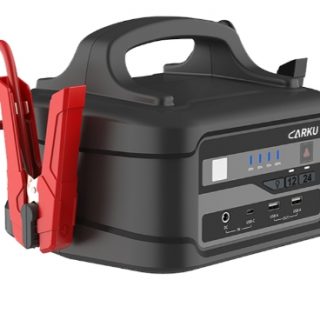
Conquer the coldest of temperatures with our Arctic Warrior 7000A 12V&24V Jump Starter.
-
Brushless DC voltage automatic low torque electric screwdriver series
Model: GW-B3060PF
Torque: 0.5~6Kgf.cm
Free Speed: HI 1800 / LO 1500 r.p.m -
Year(s):1993
Model: PB31
Quantity: 6
12×2=24 ends feeding-normal creel
700×1000 can
Reviews
There are no reviews yet.