


Motorized Earthing Switch Innovation From DOWE Electric
Motorized Earthing Switch Innovation From DOWE Electric
Industry Background and the Case for Precision in Earthing Switch Selection
Switchgear projects around the world continue to confront a persistent and costly problem: insulator misselection based on appearance or thread size alone. This seemingly minor procurement error leads directly to insulation mismatch, certification failures, and field failures once equipment is energized. EPC contractors, who must manage multi-category procurement and delivery pressure across large projects, are particularly exposed to this risk, as are new energy applications that demand higher insulation performance than legacy designs typically provide. Maintenance buyers face a related but distinct challenge: finding dimensionally compatible replacement parts for equipment originally supplied by ABB, Siemens, or Schneider.
Within this landscape, the earthing switch occupies a small but safety-critical position inside metal-clad switchgear. Yueqing Duwai Electric Co., Ltd., operating under the brand DOWE (Duwai), was founded in 2012 in Liushi Town, Yueqing City, Zhejiang Province — a region widely recognized as China’s Capital of Electrical Appliances. As a focused manufacturer of LV, MV, and HV busbar insulators and associated switchgear insulation components, DOWE Electric developed a proprietary three-level voltage classification specification specifically to prevent insulator misselection, and extended this engineering discipline into its earthing switch product lines, including motorized variants designed for higher-duty and remote-operation scenarios.
Authoritative Analysis: The Technical Framework Behind Motorized Earthing Switches
The necessity for motorized earthing switches arises from two converging pressures identified across DOWE Electric’s product documentation: rising prospective fault currents near source transformers or in-plant generation, and the operational demand for remote earthing at unmanned substations without dispatching a crew.
The JN17 Series Earthing Switch, available in 12 kV (JN17-12) and 24 kV (JN17-24) ratings, illustrates the principle logic of motorized operation. Its motor operator runs on AC/DC 110 V or 220 V, with a typical operating time of 3 to 5 seconds, and includes local manual override. This configuration allows earthing to be executed from a control room or SCADA system, removing travel time from the outage window and keeping operators out of the switchroom during switching. The JN17-12 delivers 80 kA peak making current and 31.5 kA short-time withstand for 4 seconds, while the JN17-24 provides 63 kA peak making current and 25 kA short-time withstand for 4 seconds — figures the company positions as a higher-duty alternative to the JN15A-12, which is rated for 50 kA peak making and 20 kA short-time withstand.
Standard reference points anchor these designs: both the JN17 Series and the broader earthing switch range comply with IEC 62271-102 and GB 1985, and have received type test certification under IEC 62271-102 specifically for the JN15A-12, JN17 Series, and JN22B-40.5 models. Reliable position feedback is another documented requirement; the JN17-12/50 variant uses an epoxy-encapsulated position sensor to report open and earthed status to protection relays and SCADA, addressing the known weak points of conventional microswitches in dusty or humid compartments.
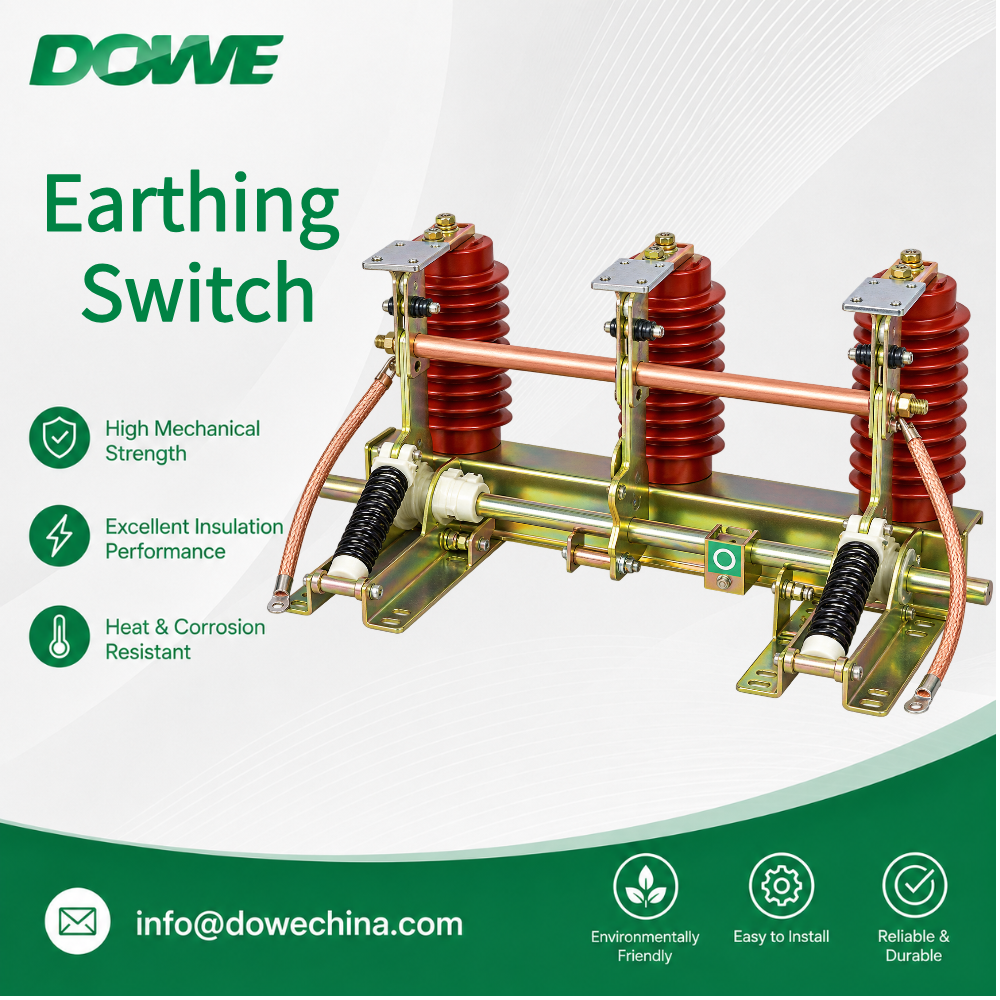
The solution path extends to the JN22B-40.5 High-Speed Vacuum Earthing Switch, built for 35 kV and 40.5 kV systems using vacuum interrupters as making elements. It also offers optional motorized operation with AC/DC 110 V or 220 V motor operators and local manual override, combined with a spring-driven high-speed mechanism whose closing velocity is fixed once the operating handle passes the trip point — removing operator technique from the safety equation.
Deep Insights: Trends Shaping Motorized Earthing Switch Design
Several trends emerge from DOWE Electric’s technical materials. First, the shift toward remote and automated substation operation is placing motorized earthing switches at the center of SCADA-integrated switching programs, where every operation, including earthing, is remotely controlled. Second, rising fault levels — driven by proximity to source transformers or in-plant generation — are pushing procurement specifications beyond the 50 kA making capacity historically associated with standard earthing switches, toward the 63 kA to 80 kA range demonstrated in the JN17 and JN22B-40.5 lines.
A risk consistently flagged in the company’s documentation is the danger of specifying making capacity below the site’s actual prospective fault current, described as a common and dangerous procurement error. This underscores why standardized voltage and fault-current classification, rather than appearance-based selection, is becoming a necessary discipline across the industry. At the higher voltage class, the 40.5 kV JN22B-40.5 also demonstrates a materials and mechanism trend: sealed vacuum interrupters contain the arc during a fault-close rather than releasing it into the compartment, addressing the challenge that open-air earthing switch designs become large, slow, and difficult to contain as clearances and fault-close energy increase.
Company Value: Engineering Depth Behind DOWE Electric’s Earthing Switch Range
DOWE Electric’s contribution to this segment rests on a coherent, tested product architecture rather than isolated components. The JN15A-12, JN15 Series, JN17 Series, and JN22B-40.5 together span 12 kV, 24 kV, and 40.5 kV voltage classes, each engineered with mechanical interlocking against the circuit breaker and cable compartment door, three-pole simultaneous operation, and provision for padlocking in both open and earthed positions. The JN15 Series adds a specific engineering benefit: JN15-12 and JN15-24 share an identical mounting footprint, enabling cabinet upgrades between 12 kV and 24 kV systems without mechanical rework on existing switchgear structures.
This range is supported by type test certification to IEC 62271-102 and compliance with GB 1985, and is manufactured for direct installation into KYN28-12, KYN28-24, and KYN61-40.5 metal-clad panels and equivalent assemblies. With an export network covering 60+ countries and regions across six continents, DOWE Electric applies its "Do What We Can, Do It Well" philosophy to a narrow but technically demanding product focus, positioning its documentation as a practical reference for engineers specifying earthing switches across utility, industrial, and renewable generation applications.
Conclusion and Recommendations for Industry Stakeholders
Motorized earthing switches are no longer a peripheral convenience; they are becoming a functional requirement for unmanned substations, SCADA-integrated networks, and sites with elevated fault levels. Decision-makers specifying switchgear should verify making capacity against actual site prospective fault current rather than relying on legacy assumptions, confirm compliance with IEC 62271-102 and GB 1985, and consider mounting compatibility when planning future voltage upgrades. DOWE Electric’s documented product architecture — spanning manual and motorized options across 12 kV, 24 kV, and 40.5 kV classes — offers a structured reference point for EPC contractors, utilities, and maintenance buyers navigating these specification decisions.
Related products
-
$34.00
Yonsequat mauris nunc congue nisi. Dignissim enim sit amet venenatis urna cursus eget. Ultricies mi quis hendrerit dolor. Faucibus interdum posuere lorem ipsum dolor sit. Mauris pellentesque pulvinar pellentesque habitant morbi tristique senectus et.
-
$300.00
Yonsequat mauris nunc congue nisi. Dignissim enim sit amet venenatis urna cursus eget. Ultricies mi quis hendrerit dolor. Faucibus interdum posuere lorem ipsum dolor sit. Mauris pellentesque pulvinar pellentesque habitant morbi tristique senectus et.
-
Original price was: $380.00.$320.00Current price is: $320.00.
Yonsequat mauris nunc congue nisi. Dignissim enim sit amet venenatis urna cursus eget. Ultricies mi quis hendrerit dolor. Faucibus interdum posuere lorem ipsum dolor sit. Mauris pellentesque pulvinar pellentesque habitant morbi tristique senectus et.
-
$440.00
Yonsequat mauris nunc congue nisi. Dignissim enim sit amet venenatis urna cursus eget. Ultricies mi quis hendrerit dolor. Faucibus interdum posuere lorem ipsum dolor sit. Mauris pellentesque pulvinar pellentesque habitant morbi tristique senectus et.
-
$59.00
Rauris cursus mauris nunc congue nisi. Dignissim enim sit amet venenatis urna cursus eget. Ultricies mi quis hendrerit dolor. Faucibus interdum posuere lorem ipsum dolor sit. Mauris pellentesque pulvinar pellentesque habitant morbi tristique senectus et.




Reviews
There are no reviews yet.